 I visited San Juan de Dios market on the first day I arrived in Guadalajara. My Mexican "mother," Titi, with whom I was staying for five days, took me to on Sunday when most stalls were closed. I returned the next day, remembering the route she and I had walked from the IMAC school. She took me there by bus so I would know how to go to my Spanish lessons on Monday.
Whoo-ee. The San Juan de Dios market is an assault on the senses. Then you get used to its narrow aisles and vendors trying to call you over with "pasele" (come this way?) or "a sus ordenes" (at your service), hoping you'll check out their goods and buy something. Or many things. 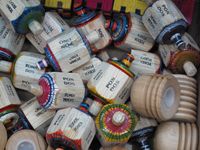
You can enter and exit the place from all sides and through many doors. The aisles start at the sidewalk outside and continue through the market, in somewhat of a grid. But not always.
If you end up exiting on the other side you can always walk around the block to find where you started, or dive back in and try to make your way back the way you came.
It's easy to get lost but I was excited to see so many goods. That is, I was ready to spend money. But after a short while, it became clear there was little I was going to buy. The jewelry was not my style and and those key chains with the small bottles of tequila? Fun to see, but not necessarily to buy. Cowboy boots? Wallets? Raw beef? I wasn't in the market for any of those things.
 There's a section of booths filled with prettily packaged sweets to sell. With names such as membrillo, cajeta de sayula, borrachitos finos and queso de tuna, which has nothing to do with the fish. Tuna in Spanish is the word for the fruit of the prickly pear cactus.
It's about the size of a kiwi, though a paler green. Nice and juicy, but with too many hard black seeds for my taste. I didn't try the candy version. I DID taste the kahlua, tequila, guayaba, coconut and chocolate flavors, however!
Those were packaged with the words, "Dulces tipicos de Jalisco," or the "typical sweets of Jalisco," Jalisco being the state that Guadalajara is in. They're soft, slightly sticky candies, way softer than gummies, and rolled in granulated sugar. These candies make more sense than "real" chocolate in a country where daytime temperatures would melt good chocolates.
I won't describe much of the meat section of the market, particularly if you're eating while you're reading this. Suffice it to say that it involved a lot of flies and a row of skinned cow heads (which my "mamita" described as delicious meat for tacos once you boil the head and remove the blood that it exudes.)
Upstairs are booths with jeans, electronics, cowboy boots, perfumes and more. Near an outside, center courtyard are booths selling all sorts of birds and assorted small animals. Making a racket in cages. I didn't enjoy seeing that.
 Two days later, I visited another market, El Mercado Corona, with my Spanish class, and some Mexican students from English classes at the school. We conversed in a combination of Spanish and English.
I wrote about that market a bit last week. Corona is much more for locals. Lots of families eating menudo, a spicy soup made with tripe. It's part lunch spot and part fruit, vegetable and flower market.
The market was built in honor of José Antonio Torres, one of the founders of México's independence movement. He was imprisoned by Spanish troops, on the site of the market.
Originally it was a convent, then a hospital, then a cemetery. Only an arch remains from those times, at the market's entrance.
Photos, Ellen Perlman
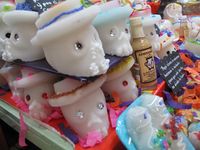
1. Sweets for Day of the Dead, a November 2nd holiday in Mexico. San Juan de Dios Market, historic Guadalajara.
2. Spinning tops, a toy similar to a dreidel, only six-sided. The markings say "put in one," "take the whole pot," etc.
3. Vendor selling exotic cowboy boots, including elephant skin and alligator. San Juan de Dios Market.
4. Sweets at El Mercado Corona, downtown Guadalajara.
5. Vat of menudo (tripe soup), El Mercado Corona.


 Boldly Go Solo
Leave a reply to Tracy Barnett Cancel reply